
This article first appeared in EarthLines magazine in August 2013. The photos are by Kev Percival, who has lived and worked on Tanera for two summer seasons.
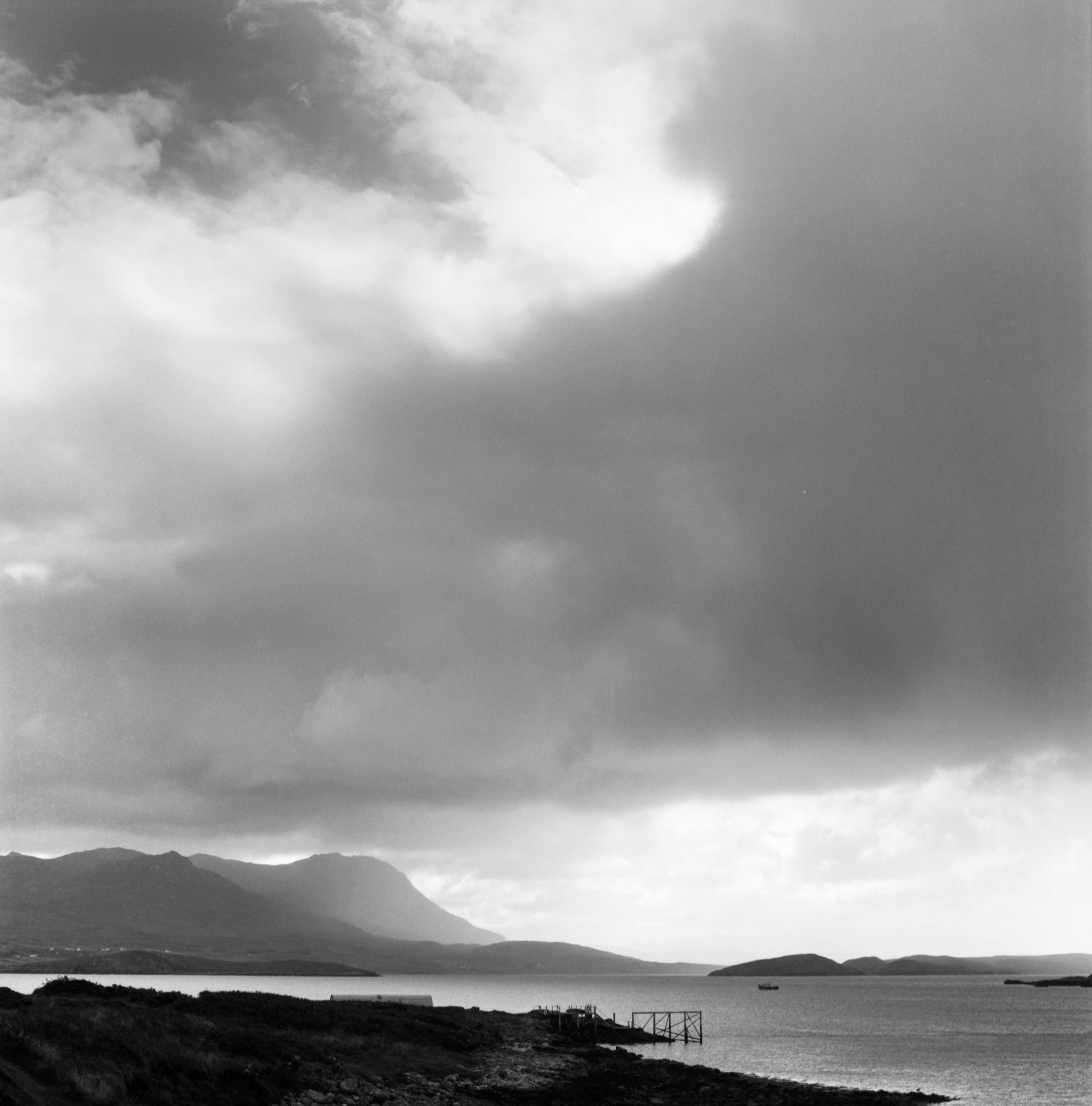
Ardnagoine pier on Tanera Mor, looking across to Ben Mor Coigach, by Kev Percival
I like a springtime dawn; you can catch sunrise without missing out on too much sleep. I particularly like a springtime dawn here on my doorstep with a high tide slopping at the bottom of the rocky path, eider ducks cooing and chuckling, greylag geese clattering, the sky quietly pinkening behind the megalithic hulks of the North West Highlands.
I may be biased, but I am quite sure that this is the most beautiful doorstep in the world. So I am rather sad that within a month we will start the process of leaving.
The doorstep is on Tanera Mòr, the largest and only inhabited of the Summer Isles – an archipelago of around 20 islands and skerries lying just off the Coigach peninsula, 40 miles (as the gannet flies) south of Cape Wrath, on this tattered western fringe of Scotland.
‘Tanera’ – from the Norse ‘Hawrarymoir’ meaning ‘Island of the Haven’ – was a haven for Vikings who used its sheltered anchorage as a base from which to plunder the nearby mainland. The population of Tanera has undulated over the millennium since the Vikings left. An etching by Daniell in the mid 1800s shows the bay bustling with sailing boats busy with the fleetingly viable herring industry.
By the early 1900s it was home to around 120 people – crofting families – but the community dwindled until the departure of young men for the 1st World War rendered its existence unviable; their crumbling cottages now crouch in the deep bracken and brambles. When naturalist-philosopher-writer Frank Fraser Darling arrived in 1939 with his wife Bobby and their son Alasdair the Island was uninhabited. They made a home amongst the ruins of the herring curing industry and rebuilt by hand the beautiful stone pier that still stands. Fraser Darling’s book Island Farm (1943) tells of the family’s efforts during the 2nd World War to demonstrate what productivity could be coaxed from the difficult Highland ground.
Today there are just three permanent residents: my husband Rich and me, and our baby daughter Rosie.
Tanera has been my home for half my life, since my parents came here in the mid-90s, but I have only lived here properly since Rich and I moved up to help manage the Island four years ago. We came here from Cambridge, in search of a more varied topography, and a more ‘hands on’ existence than our desk-bound careers allowed. Though our jobs in wildlife conservation (me) and London property development (Rich) were interesting, we seemed to spend our time advising other people without really having done anything ourselves.
We found ourselves longing to swap the conceptual for the practical, for our daily achievements to be tangible. We wanted a lower-carbon existence. We wanted to get to know a place properly; to get it stuck beneath our fingernails and to grow its calluses on our palms. We wanted a different sort of life, with fewer billboards and tarmac; more eider ducks and bladder wrack.
It wasn’t an easy decision: Cambridge had been a happy home, and we knew that island life wouldn’t be all sunny afternoons in sailing boats. But we knew we would always regret it if we didn’t at least give Tanera a try.
~ ~
The population swells in the summer months. Six holiday cottages fill with families, or with artists – painters, writers, weavers, knitters – on
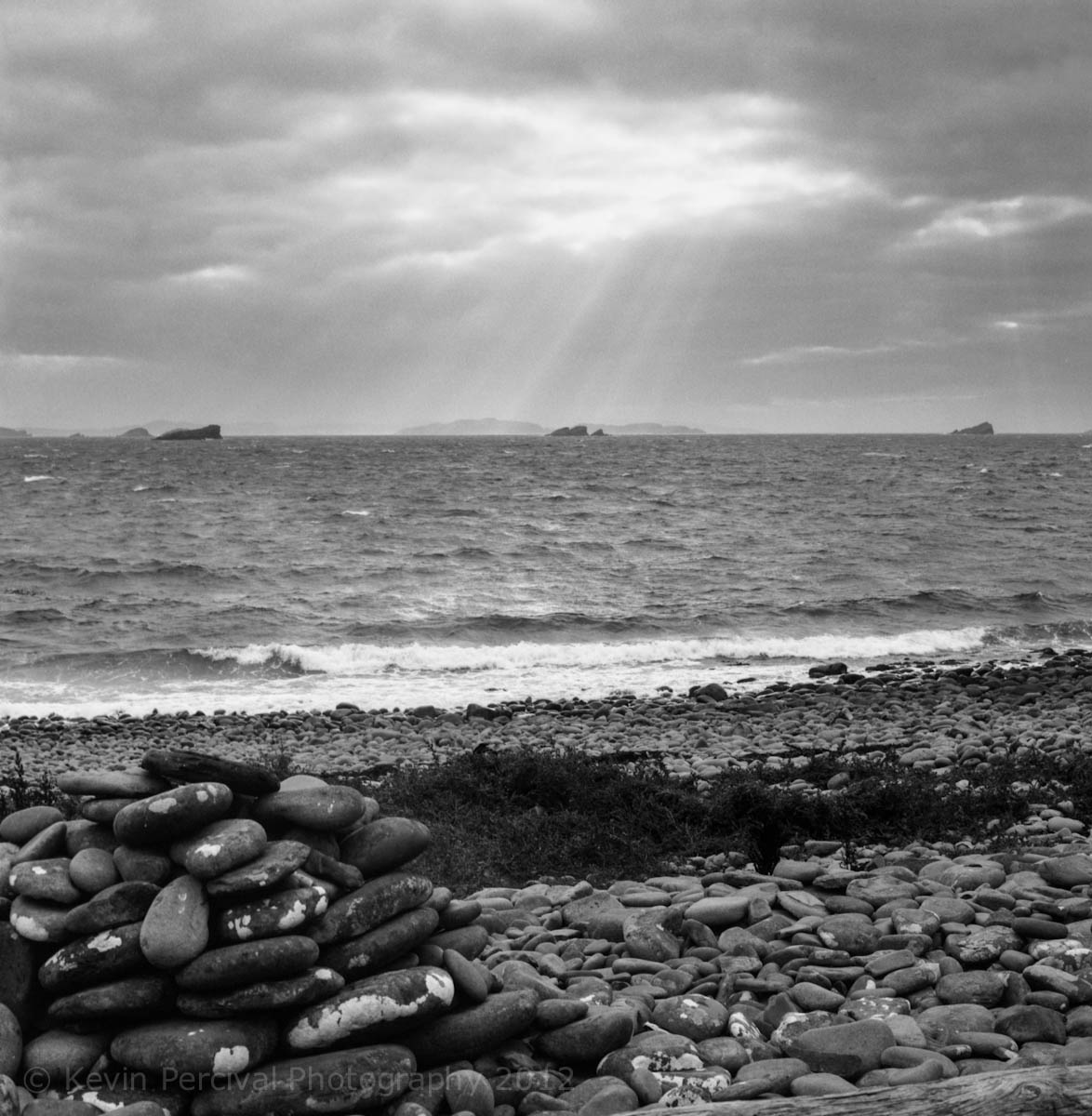
Mol Mor – the big beach on Tanera, by Kev Percival
a residential course with one of the many talented local tutors. The Cafe serves local cruise boat visitors, who buy Summer Isles stamps from the ‘private’ Post Office. The sailing school introduces holiday-makers or local children to dinghy sailing, and this summer we will host our first John Muir Award for the local High School.
I find an unexpected joy in witnessing our visitors transform from their arrival on a Saturday afternoon – ragged from the pre-holiday work rush, haggard after a long journey – unfurling throughout the week like dehydrated pot plants after a good watering, and leaving refreshed and rosy-cheeked. Urban children enjoy freedoms unthinkable in the city, entertaining themselves without telly and internet, exploring the hill and shore. We hope they are developing a love and respect for this wild place, which may have an impact on how they think about other wild places and perhaps – and I know this is optimistic – even how they treat the world.
This wild place is about 800 acres of dry heath, bog, rocky outcrop and woodland. No roads, few paths. On the west coast, aeons of wind-battering has whittled and pitted the sandstone; fulmar, cormorants and shags nest on ledges, pestered by skuas. The wee lochans inland are a source of drinking water for us, but also a summer home to a pair of Red Throated divers.
There are no rabbits or deer on the Island and sheep haven’t roamed freely here since the mid-80s: perfect conditions for recreating a patch of the scrubby woodland that covered the Highlands before it was nibbled tight. My parents (with a little help) planted more than 164,000 saplings of birch, willow, alder, rowan, oak, aspen and beech which now huddle in clutches all over the Island. Some are doing well – we already coppice alder for firewood – but some are woeful wee things, still just inches high after more than a decade battling the elements. Native woodland is also regenerating enthusiastically, in places it tumbles right down to the sea.
Other flora also enjoys the freedom from herbivory, growing taller and stronger than their mainland cousins. Blue heads of Devil’s-bit scabious – in Gaelic Bodach Gorm, ‘Blue Old Man’ – nod sagely; yellow stars of bog asphodel light the bogs, and it’s hard to resist the temptation to bounce on the huge sphagnum moss cushions strewn about the place.
Grazers do have their place though, and my parents have used small gangs of highland steers to break up tussocks and create a richer grassland flora. The cattle were effective and picturesque, but not easy to manage: even the most docile beast can do some serious accidental damage wielding those massive pointed horns. So when the last elderly gentleman shuffled off this mortal coil last spring we borrowed some Hebridean sheep instead, and have fenced them carefully.
In contrast to the wild west coast the sheltered east-facing bay has rather an air of domesticity. Boats sit obediently, tethered to their brightly coloured mooring buoys, or putter between the three piers or across to the mainland (a journey of five or twenty minutes, depending on how much fuel you’re willing to burn).
Inquisitive youngsters from the Atlantic and Common seals colonies on the other sheltered Summer Isles often hang out in the anchorage. An otter is a special sighting; last spring we occasionally saw a tangle of youngsters playing in the bay just below the house.
The birds are the bay’s main characters. Many go away for the winter months to feed at sea and rest the breeding grounds, but in early March greylag geese start hanging around in romantic pairs on beaches and in long grass; their soft chuntering so familiar, subconsciously comforting in the way that friendly voices are. Their uproarious leave-taking is less soothing.
Soon after, oyster catchers return for graceful synchronised flying duets and carrot-faced strutting on the shore. A curlew’s call is less hysterical – more melancholy – than the oyster catcher. The territorial drumming of a snipe’s tail feathers at dusk is, for me, the sound of Spring, whilst the all-night parties of sandpipers and common gulls exacerbate the problems of sleeping on dark-less midsummer nights. Of course one shouldn’t have favourites, but mine are the eiders who gather in rafts; a chorus of surprised ‘ooOOoo’ from the piebald males with a baseline of gentle ‘kakaka’ from the nut-brown females. These are sounds that bypass my frontal lobes and ignite an inner grin.
From late May the bay babbles with fluffy youngsters. We watch in horror as the gulls and crows circle and the numbers gradually dwindle. By the end of August it’s suddenly all over: adults and their few surviving young head off to sea and the bay is quiet again.
I instinctively feel grateful – proud, even – that the birds have ‘chosen’ ‘our’ bay to raise their families. Of course this is ridiculous: they have been breeding here since long before we arrived – long before the Vikings. Perhaps – particularly as a biologist by training – I should reprimand myself for such sentimentality.
But I go easy on myself for anthropomorphising the wildlife: I’m not reducing their behaviours to those of humans, but expressing a companionship. A companionship that is perhaps stronger because the human spirit needs to feel part of a community and much of time there aren’t many other people around. The more we learn about the birds whose space we share the more we respect them. From respect grows love, and a need to nurture and protect.
~ ~
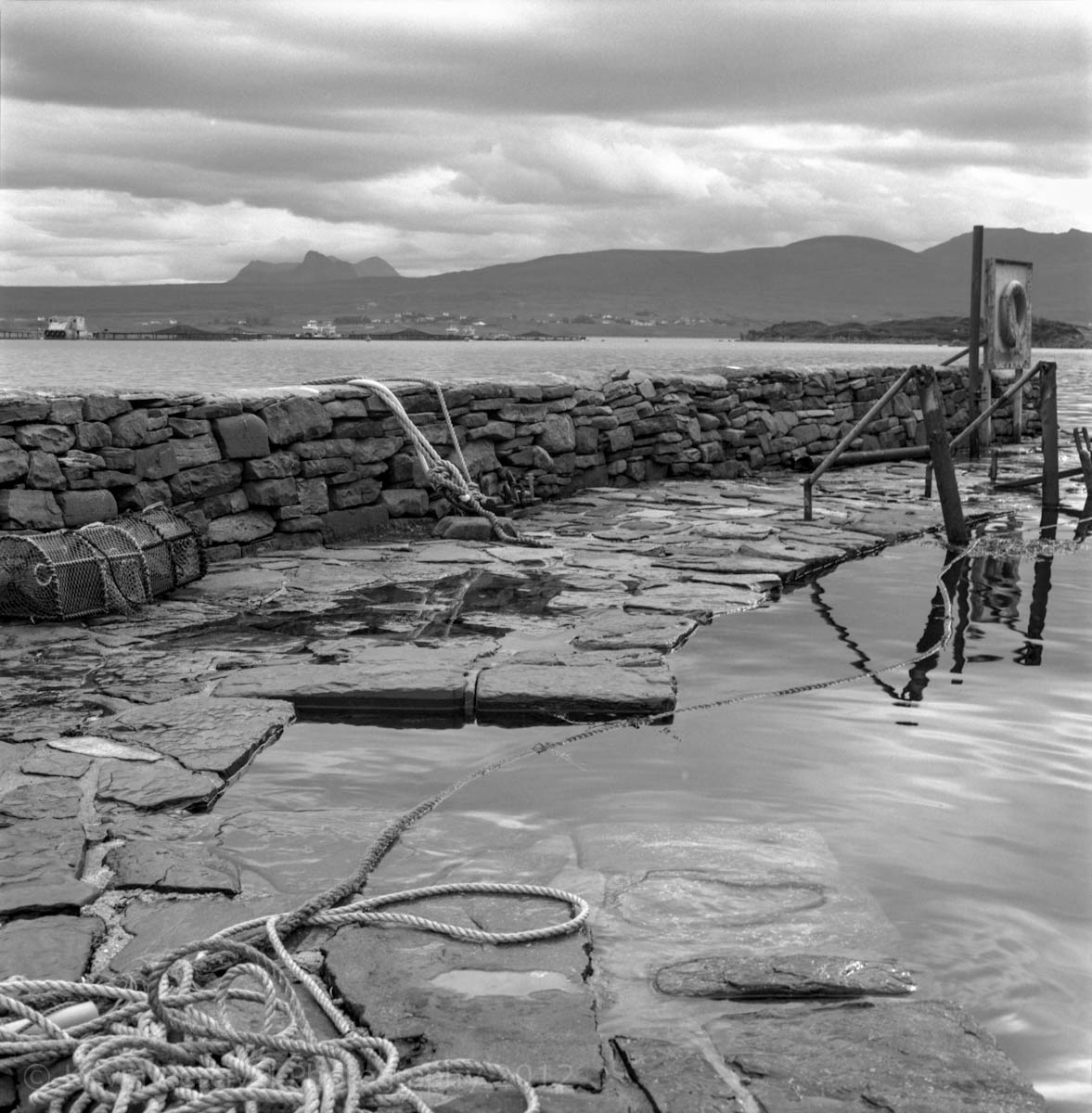
Tigh an Quay pier, Tanera Mor, by Kev Percival
Throughout the summer we are repeatedly asked by visitors, ‘What’s it like in winter?’ On hearing that we are here alone for much of the year, they swiftly follow with, ‘But don’t you get lonely?’
Perhaps we should have more patience with this line of questioning, but I’m quite sure that many questioners have already decided that it is dark, windy and wet and, in their schadenfreude, are eager to hear about our longing for a more conventional existence.
So I try to explain that winter really is quite wonderful. After the rush and bustle of the summer season meeting the needs of our visitors, it’s a treat to set our own pace and get on with substantial projects.
Yes, it can be rather dark, windy and wet but that’s ok (as long as we’re not trying to go anywhere) and when the sun shines lazy-low on snowy hills…well, frankly, one runs out of superlatives. There’s the occasional twinge of loneliness (though I miss the greylags and eiders as much as our guests) but we are welcomed warmly by the small but busy community over on the mainland. The Coigach Coastal Rowing Club relish Rich’s graft-strengthened muscles, and Rosie is a precious potential addition to the ever-dwindling primary school roll.
I often sit in an old ruined cottage and wonder at the fortitude of its inhabitants, over a hundred century ago, enduring winter without the miracles of telecommunications, online weather forecasts, oil-skins and boats with engines.
But despite our luxuries, there are still difficulties. Whilst it is humbling to have our daily activities dictated by weather and tides, it is frustrating to caveat every plan with ‘weather permitting’. We look after our own water, electricity and heating systems, keep houses weather proof, and several boats running reliably: Rich has become an impressive ‘bush’ plumber-electrician-mechanic. There is satisfaction in this moderate self-reliance, but sometimes – when the generator packs up, the water stops running, or heaving yet another gas bottle up the hill seems just too much – we’d quite like to stamp our feet and run crying to a utilities provider.
And then there are the days – particularly as autumn rots into winter – when the world seems to be a study in brown and grey. Brown heather, brown bracken, brown water running off the sodden peat across grey rocks and brown seaweed into grey sea, indistinguishable from grey sky. The mainland is a featureless brown smear often disappearing behind grey clouds. On days like these it is tempting to retreat behind thick stone walls, confine our interaction with the natural world to the log basket, and wonder what a pair of gregarious 30-somethings are doing, living alone on a soggy windswept rock in the sea.
But it just takes a little attention and imagination, a lungful of fresh air, and perhaps a helpful wink of sunshine, to see that it’s not just brown and grey at all.
Mosses shoot up fruiting bodies like orange periscopes; chartreuse lichens have scarlet red caps and others are dog-tooth hairy; aspen leaves flutter like a cloud of yellow butterflies and alder buds have little blue mittens. Emerald liverworts in damp crevices are relics from 470 million years ago, but even they seem like recent arrivals compared to the rocks of this strange ragged landscape of Lewisian Gneiss – formed three billion years ago, before the evolution of multi-cellular life! – and Torridonian Sandstone, just 800-1000 million years old.
So – what of our idealistic fenland dreams? We have made substantial improvements to Tanera’s carbon footprint – we’ve updated rickety

Tanera wood, by Kev Percival
old boilers, replaced open fires with wood-burning stoves (swapping coal for wood or briquettes), improved many of the draughty single-glazed windows and, just last month, Rich and a local wind engineer erected a mast system (using reclaimed materials) on which two dainty little wind turbines sit, whirring like giant dragonflies in the slightest breeze. But for our electricity we are still predominantly dependent on diesel-powered generators running several hours a day.
We hoped to achieve a little self-sufficiency but, after an enthusiastic start our vegetable production efforts shrivelled; it turns out that the tourism season coincides with the gardening input season. The same goes for foraging in the sea. We just have to accept that neither time nor energy are elastic, and during the summer season any spare snatches of either are generally spent in kayaks escaping the busy bay for some proper wild.
The Island is under our fingernails and also under our skin; our muscles are strengthened by this physical existence, our ligaments loosened by years of welly wearing on steep rocky paths. We have learnt so much – about ourselves, and our limits of endurance and self-reliance – and these are lessons that we will take with us wherever we go.
Tanera feels like home in a very visceral sense; there is a deep relief in my stomach on spotting her highpoint from the Ullapool road after a long day in Inverness. The monstrous rocks of Ben Mòr Coigach, Stac Pollaidh and Suilven were too dramatic and hostile when we first moved here, but they now feel like old friends.
Nevertheless, we’re leaving. There are various reasons, mostly mundane, to do with sharing the family’s resources with my southern-dwelling brothers. A less mundane reason is Rosie: I have been gathering all these words in between nappy washing and parsnip mashing, with barely a mention of the rosy-cheeked, tangerine-haired bundle of grins and giggles who is now my life. Visitors to Tanera gush, ‘What a magical childhood she will have!’ In many ways they’re right, but the reality of climbing down high pier ladders onto bouncy boats is difficult. It’s ok whilst she’s still small enough to be strapped firmly to me, but things can only get trickier as she gets bigger and wrigglier, and what if she comes by a sibling?
But although we must move on from Tanera, I don’t think we’ll be going far. After just a few years up here we would struggle to settle back into cluttered southern life. We may never find quite such a wonder-full doorstep, but we are looking. And whilst we are nurturing a new home, we will be hoping very much that someone else is looking after Tanera.
About the photographer: KEVIN PERCIVAL is a freelance photographer trained at Staffordshire University (BA Hons). His current practice involves both landscape and documentary work both for exhibition and publication, using a combination of traditional film and digital processes. His inspiration ranges from the Peak District landscape where he was brought up to his new home in the Scottish Highlands on Tanera Mòr. He hopes to raise awareness of ecological and sociopolitical issues with his subtle black and white imagery. www.kevpphotography.co.uk.
 Wilder Words