
Just making the most of some morning sunshine… a quick woosh around the peninsular after dropping off the kids, and before settling down to wrestle with WordPress. (A baffling occupation.)

Just making the most of some morning sunshine… a quick woosh around the peninsular after dropping off the kids, and before settling down to wrestle with WordPress. (A baffling occupation.)
May 2020
Early in the Lockdown I had a dream – a dystopian nightmare – in which the world was so broken that even the swallows couldn’t migrate this year. I was therefore extra overjoyed, and so relieved, when at last they appeared (on April 21st) cruising high overhead, then chattering on telegraph wires, and eventually moving back into the shed.
Yes: the basics of natural order are still (just about) intact and for many of us the unfolding of Spring has felt particularly poignant this year as the world stands still. Some have appreciated the companionship of creatures in the absence of human contact; some have had more time to notice Nature and the Small Things… which are for me the Big Things: essential anchors in life. I think most of us feel lucky – privileged, even – to be in this spectacular place at this extraordinary time. So we thought it would be nice to do a bit of a ‘Springwatch’.
We are all marooned together on this peninsular, looking out over these views, so I won’t witter on about the exquisite light on An Teallach’s cauldron, or how the Outer Isles hover on the afternoon haze. But here are a few undisciplined noticings of Spring’s progress from the south end of the road. It is not a comprehensive record – in particular I’m missing the shore birds – and I am not an authority… I will enjoy any geeky Amateur Naturalist chat and feedback.
I’m writing in early May when Spring is in full-frenzy, but my first reassurance that winter might end comes in mid-March when the classy wheatears return from central Africa, loitering by a path then darting off – a flash of white rump looping low ahead. Pied wagtails strut cockily on the lawn. In early April (4th this year) pink-footed geese pass in squeaking skeins en route from their winter on soggy southern fields to the all-night eating opportunities of the Arctic Circle.
Delicate willow warblers arrive a little later (16th April), flitting about in the stubby catkins; their descending trill is a definitive sound of Spring. As is the cuckoo; quintessential harbinger of Spring bpre-dawn wakeup call. Is the female’s throaty cackle mocking us in our insomnia? The poor, parasitized pipits chase them furiously.
Sheltered cracks harbour primroses even in mid-winter, but by mid-April there are cliff-fulls of them. Gorse creates its own microclimate, with internal sunshine and full surround-smell. The monochrome heath is now lit with pink lousewort, indigo milkwort and the podgy yellow-green leaves of butterwort. One dawn amongst the brown I spotted my first emperor moth: a female (no huge feathery antennae) – she was many rich browns and buff, with striking eyespots and a flash of red. The caterpillar (in case you ever see one) is improbably green, with spikes and spots.
At dusk I watch a crimson-scarlet smudge in the north west, and Venus gleams above Tanera. A Snipe drums his tail feathers in an aerial courtship display overhead, like a huge elastic band twanging in the darkness. (Is it a rival male at ground level who frantically squeaks in response?) Further off a red throated diver wails hauntingly. The swallows hunting amongst the Spruce-tops have just become pipistrelle bats. This is definitely a very good place to spend Lockdown. Until the midges come, perhaps.
This piece first appeared in the ‘Coigach Newsletter’, May 2020.

We began May lounging around in blissful midge-free sunshine, waiting for rain to plant up the raised beds and a new wildflower meadow. But the compulsory Spring storms didn’t disappoint, even throwing in a spot of ‘lambing sleet’. Deep puddles strewn with shredded leaves and gorse flowers are a classic May sight, as is the brown seaward face of trees and shrubs: delicate baby leaves burnt by the salt-laden wind.
Just before these salt-scorching storms, a hillside was scorched in an accidental wildfire. Miraculously (and thanks to the diligence of the firefighters who battled it) nobody was hurt and the flames largely spared the precious woodland that lines the burn tumbling off the hills and down through magical fairy pools. All the hillsides gush green briefly in June with deer grass and bracken, but beneath the flush of grass this burnt patch is still black as the ravens who cronk above it.
Elsewhere on the hillside, insectivorous butterwort is joined by its midge-eating partner sundew. Heath spotted orchids and bell heather are emerging; cotton grass nods in the bogs. Orange-tip butterflies flit around the shins and a large red damselfly warms itself in the heather. In soggy ground yellow flags are unfurling and warm air is heady with bog myrtle (which is said to repel midges – but really, does anything?). A dainty fringe of mauve wild thyme, yellow tormentil and white heath bedstraw freckles the roadside. Clumps of bird’s-foot-trefoil and sea pink make a pretty ensemble on licheny sandstone, whilst Achnahaird’s field of sea pink is an almost-preposterous luxury.
Any lowland walk at this time of year is accompanied by the tchak tchak of a Stonechat: black hat and back, crisp white collar and blush-orange chest, sparrow-sized. Recently I thought I’d seen a pair of massive ones, as big as blackbirds, sitting on a fence … but they turned out to be ring ouzels, probably just passing through en route to breed on higher ground. They’re on the UK Red List of Conservation Concern, as are several other birds we might consider common: the shag, curlew and our favourite alarm-clock cuckoo.
The wildlife charity PlantLife promoted #NoMowMay, which we happily embraced in our garden. The lawn is now thick with lacy pignut and magenta northern marsh orchids. ‘Our’ swallows swoop low over it, hoovering up a rich insect meal. Lately they have been joined by house martins, who somehow resemble dumpy flying penguins but are no less agile than their long-tailed cousins.
Lockdown has kept me off the sea for the first time in a decade; I have no idea what the birds and beasts are doing out there. I heard the puffins had passed through in April… but where have the terns chosen to nest this year? How are the fulmars, eiders, black guillemots? Any cetaceans? I feel I’ve been neglecting these old friends, but I don’t expect they’re too bothered. Nature: unaware that the human world is racked with chaos and torpor, and oblivious to the distraction and sanctuary it offers us when we stop to notice.
This piece first appeared in the ‘Coigach Newsletter’, June 2020.
Autumn. Water-bird babies have fledged, we have waved goodbye to our summer visitors and staff, and now we three are alone on the Island again.
We will probably be running Tanera next summer (the Island has not yet been sold, so do book a cottage if you’d like to!) but the time has come – as we head into our fifth winter of isolation – to see if we can handle life on the mainland. So we are moving to a new home in Achiltibuie.
As with everything Island-related, moving house isn’t entirely straight forward: eyeing the forecast for a dry calm day, lugging cumbersome furniture down the mossy path to the pier, then down sea-weedy steps onto Patricia’s deck (high-tide is good), crossing to the mainland and up the pier into our trusty (rusty) transit van.
But the final part of the procedure is luxuriously simple: just drive right up to the door and heave it all into the house.
Not needing to triple-handle every bit of luggage or grocery is one of the many luxuries we will find in our new mainland life. We will get so fat!

We will miss this view
Amongst other luxuries there will be an electric kettle and an electric toaster (both unbearable for Tanera’s generator-battery system): no longer will breakfast be tyrannised by screeching steam and carbonised toast. We won’t need to scour forecasts and tide-tables, or caveat every plan with ‘weather permitting’. A trip to Toddler group will be child’s play! (Haha.)
But luxury is in the eye of the beholder, and in my humble opinion, life on Tanera is luxurious in the extreme. I’ve written here copiously about the delights of the bay below our house: the gentle “oooOOooo” of eider ducks, the hysterical shrieking of oyster catchers… seals, otters, phosphorescence… and last week I had to hang up mid-phone-call and dash down the path to watch a basking shark ambling by, just metres from the pier.
We will miss the lavish non-nibbled vegetation, particularly the sumptuous cushions of sphagnum moss, the bog asphodel, devil’s bit scabious and red clover, and the licheny tangles of native woodland. We will miss the sense of wild liberty of having our own big space. We will miss the view.
I probably shouldn’t grumble. Our new home also has rather a nice view, South West across the Summer Isles to Torridon. There is a little patch of conifers waiting to fill our wood burner and be replaced with some nice native species, and I’ve fallen in love with the peaty burn that tumbles down from Ben Mor Coigach and out to sea at a sandy beach a short walk from the house.
So, after three happy years columning here, now seems a sensible time to close. I hope to make occasional contributions to this publication, and certainly plan to keep writing about our new surroundings, Tanera’s future, and the environmental issues close to my heart. Thank you for reading me.
This article first appeared as a column in the magazine Scottish Islands Explorer – November-December issue 2013.
Readers of the May issue may remember my grumbles at the thought of ‘heaving a heavy wooden boat through the waves’. Happily, I seem to have got over the grump; the inaugural St Ayles Skiff World Championships was held in nearby Ullapool last week, and our local boat the Coigach Lass was on quite the finest form.
The story of the St Ayles Skiff is short so far, but remarkable. In 2009 the Scottish Fisheries Museum instigated a wooden boat building project and commissioned a simple design which could be supplied in kit form to be built cheaply by amateurs, and based it on the 22ft skiffs raced by Fife coal mining communities until the 1950s.
They envisioned a handful of boats being built and raced by communities around the Forth, but the concept has taken off like … well, like the Coigach Lass from the start line. 25 clubs have formed around the Scottish coast, including teams from the Isles of Lewis, Islay, Seil. 56 skiffs have been launched across the world (from Pennsylvania to Tasmania) and another 50 are in construction.
A skiff is powered by four rowers each heaving a heavy wooden oar, and a petite Cox handling the rudder and yelling a lot. It’s physically tough, but these colourful boats are stable and safe for the whole community.
The Scottish clubs have held regattas for the last few years but this is the first time boats from foreign shores have come together. It may not be a World Championship on the scale of some other sports, but with teams from Europe, North America and the Antipodes, and an opening ceremony starring HRH Princess Anne, it felt pretty substantial.
The competition was certainly substantial and the pressure, having won every race at our own regatta, was high. From the Under 16s to

Wilders and Williams, by Anne McGee
the Over 60s (featuring my wonderful parents) and all the categories in between, Team Coigach donned our sky blue t-shirts and went into battle.
Rich and I – relatively fit and strong from years slithering around Tanera’s paths hauling gas bottles / baby / other people’s holiday luggage – were honoured to row for the Mixed Open, and the Men’s and Women’s Open teams…and we were delighted to win.
The smallness of our community could be a disadvantage as we have just 270 people from which to select our teams. But perhaps our strength is in our smallness: about a tenth of the population have been turning out for training since early Spring, and many more came to roar from the shore. Our victories were definitely a community-wide team effort, and Rowing has nurtured the sort of social cohesion of which many-a government or NGO programme can only dream.
And maybe the same tenacity (stubbornness?) that sees us clinging to life out here also has us doggedly determined to cross that finishing line before Anstruther or North Berwick.
I don’t know what makes our wee boat the best, but we were all pretty pleased to come home jangling with medals and holding aloft the stunning (made in Coigach!) winners’ trophy.
(Writer-broadcaster-campaigner Lesley Riddoch wrote an excellent piece about the World Championships, with reference to community cohesion and land purchase – much worth a read: http://www.lesleyriddoch.com/2013/07/pulling-together-for-better-future.html; there’s also more about this budding new sport at www.scottishcoastalrowing.org)
This article first appeared as a column in the magazine Scottish Islands Explorer.
And so the time has come to begin the process of leaving Tanera. As I write in early May, the island has just been launched onto the open market. It has been a sad and difficult decision, but it is one that we always knew would have to come, and we have had plenty of time to prepare.
Last autumn we approached the mainland community of Coigach to see if they would like to purchase the island under the ‘Community Right to Buy’ legislation. They were grateful for the offer; although we are the only ones living here now, the community has very strong ties with the island: an amazing number of people in Coigach have spent time living on Tanera, or have ancestors who did.
However, after a lot of thinking and talking, and a feasibility study by an external consultant, the community decided that they couldn’t take it on. The local community development company is already immersed in lots of other interesting projects – alternative energy generation, and the purchase of the former Summer Isles Smokehouse building – and Tanera (as we know only too well!) is a serious undertaking. So: to the open market it is.
But why are we leaving? Mundane reasons I’m afraid: I own the island with my two brothers who live in the south of England with their young families, and although they love coming up here, it is time for us all to move on with our own individual projects. Tanera is a wonderful home, but my parents never intended it to be our family home forever.
Then there’s Rosie, who is very happy (well, she knows no different) to climb down pier ladders onto bouncing boats whilst strapped firmly in a rucksack. But as she gets bigger and wrigglier, things will become more difficult. And if she comes by a sibling, life will be trickier still.
There have been plenty of other island babies over the years – at one time there were around 20 children on the island’s school roll. But back then there, despite life without our modern luxuries being more difficult in many ways, there were lots of families to share the challenge of child-boat management. Not so now.
We had been expecting a little ripple of media coverage about the sale – a couple of small items on page 12 of local papers perhaps – but we were astonished to find our lovely home beaming from the front page of The Times (Scotland edition), top of the ‘most read’ listings on BBC and Guardian websites, featured on national radio and even reported in the southern hemisphere.
It seems that, whereas 800 acres of mainland Scotland would change hands without a bat of a media eyelid, an island captures the imagination. As readers of these pages will concur: an island is a special thing. We hope someone will come along and care for this lovely place as we have.
But it’s not over yet. I imagine there will be many months (and so several more columns) before there are any deals struck. In the meantime we will keep an eye on the Eider and Greylag ducklings, and enjoy our island home.
This article first appeared as a column in the magazine Scottish Islands Explorer.
I sit in a shambles. A rug strewn with curious squashy creatures; a basket full of clean nappies; garish plastic crockery on the draining board. Upstairs the music box tinkles a very familiar tune, counting a few moments of quiet before a little voice starts chattering again, cheerfully announcing that nap time is over.
I must admit that these days I find it difficult to think about – let alone write about – anything that doesn’t directly concern Rosie. But at this time of year I am usually in a frenzy of pre-season preparation, so I ought to try.
The cottages are gradually getting clean, warm, and ready for inhabitation. Generators, water systems and even boilers are running without too much grumbling. There’s no point scrubbing the cafe floor before a weekend willow weaving course and all the snippings and scuffery that it entails. But the cafe kitchen will be spick and span and full of scones before the arrival of our first waterborne visitors on the Hebridean Princess.
We think back to previous seasons, wondering how to better prepare ourselves this year. Unfortunately we can do little to prevent one of the major calamities of last spring. As I reported here, at the end of a dry May we suffered a wild fire which was probably caused by an incompletely extinguished camp fire.
The grumpy equinoxal weather as I write makes it difficult to imagine ground dry enough for wild fires this spring. But even so, I can’t miss an opportunity to urge any readers with camp-fire-making tendencies to please – wherever you are – be sure that you extinguish even the most innocuous-looking ember. Or better still, perhaps do without a fire.
Of course, ‘muir-burning’ is a feature of heathland management. Burning old woody heather and allowing tasty green shoots to emerge can benefit sheep and red grouse, as well as species of conservation interest such as skylark, black grouse, northern brown argus butterfly and juniper. However, this carefully managed burning must take place before April 15th to minimise interference with breeding creatures: an out of control fire in late May is not good news.

The power of the highlands, by Anne McGee
We were lucky last year with just 45 hectares damaged. But charred saplings and displaced breeding birds were a miserable sight. Whilst I wouldn’t object to a nice dry spring, I hope for fewer careless fire-starters this year.
A nice dry spring would definitely be welcomed by the local coastal rowing team who are venturing out onto the water again. Almost
unbeaten in 2012, there is a new challenge this July: the World Skiff Championships are coming to nearby Ullapool. The team are recruiting ‘strong young women’ and (in what I can’t help feeling is a slight bribe) are building a second beautiful boat named Lily-Rose, after our Rosie and the next youngest member of the community.
I groan and shiver at the thought of heaving a heavy wooden boat through the waves. But what an honour it would be to participate in such a stunning spectacle! And at least I have a 10kg weight to train with day-in-day-out. Oh – is that her awake already? Time’s up…
This article first appeared as a column in the magazine Scottish Islands Explorer.
The island is closed for business from November to March, but still we have visitors.
A sodden winter Monday morning: grey sky, brown bracken, grey sea. We’re huddled around coffee mugs, peering out at the day through foggy double glazing.
A whir of wings, a sky full of babble, and every tree in sight is crowded with small plump birds: a gang of Bohemian waxwings has arrived. A small flock has been roaming the rowans on the mainland, but here are a couple of hundred of the appropriately chatty Bombycilla garrulous.
With jaunty head crest, red and gold wing decorations and a cheerful trill, these birds have certainly brightened a drab day. Like school children they dash around the sheltered wooded slopes of the island. Resident blackbirds and thrushes cluck testily, indignant to be sharing their bumper crop of berries with these mohawked hooligans.
Five days later the nomadic waxwings disappear as abruptly as they arrived, leaving every rowan tree stripped bare. They’re off to ransack someone else’s berries before returning to northern latitudes to breed. At least they’ve left the grazing intact…
Meanwhile, our patches of species rich grassland remain perilously grazerless since the ‘departure’ of our highland steer last spring. Old tall stems die and slump, smothering fresh growth. Bracken and heather are encroaching. Mechanical mowing options are limited, expensive and/or labour intensive. We needed some beasts to unclog the pastures through the winter and leave them ready to bloom.
Transporting animals to the islands for seasonal grazing is not a new idea; the name ‘Summer Isles’ probably refers to their use as a summer pasture when cattle were the crofters’ main livestock. Now cattle have been replaced by sheep, many of the other Summer Isles are used for winter grazing instead.
Angus Macleod, an Achiltibuie crofter, was delighted to have some new winter pasture for his wethers (castrated male sheep). Most locals keep bulky white Cheviots, but Angus has Hebridean sheep.
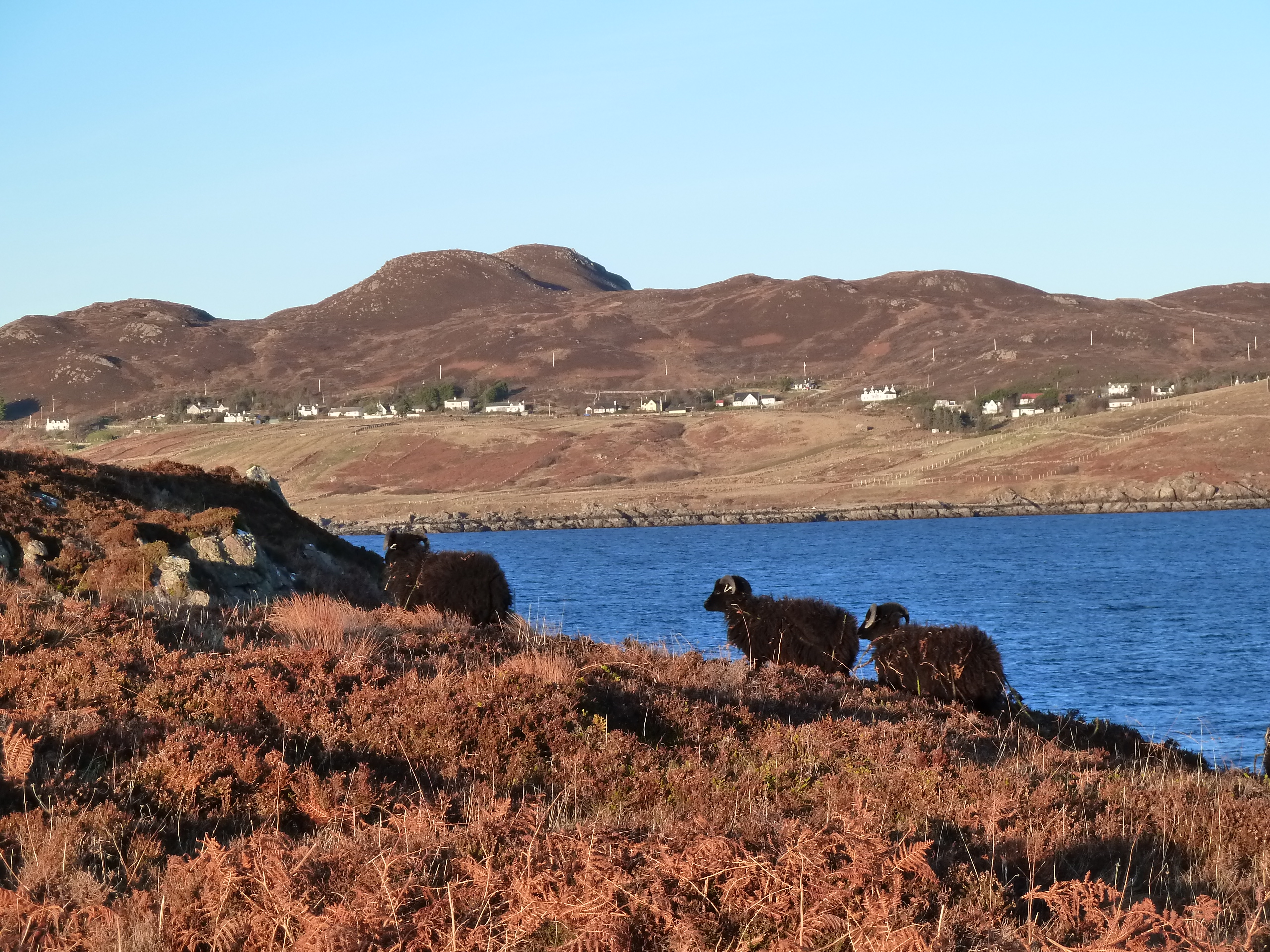
Black sheep ~ blue skies
These dainty black creatures with small curled horns and a wild hairy fleece are descendants of the sheep kept by our Iron Age ancestors. They are hardy enough to withstand the fierce weather of the western isles and, because they can survive on low-energy vegetation and don’t have the same nibble-all tendencies as other sheep, Hebrideans are now being used as ‘conservation grazers’ in national parks and sensitive ecosystems.
So it was a privilege to load up Patricia with 18 of these special ‘historical’ animals. Their small bodies and horn ‘handles’ made them easy to pass aboard. We chose a calm day for the crossing (only Ron the sheepdog seemed to suffer seasickness) and the sheep seemed immediately at ease as they explored their new home in the wintry sunshine.
Of course it’s not all straight-forward. The sheep seem particularly attracted to the sweet grass beneath brambles. Unfortunately the brambles are particularly attracted to their long fleeces and, being so small, the sheep aren’t strong enough to pull themselves free: their ‘Power: Velcro’ ratio is wrong. I just hope they sort themselves out in time to do some useful eating before spring.
In our more pensive moments we think of Island living as a microcosm of ‘normal’ life with lots of elements accentuated – the need for cooperation, partnership and mutual dependence in particular. There is strong dependence between the three of us… I depend on Rich to haul firewood and gas bottles up the perilous path to our house; Rosie depends on me for regular feeding; we both depend on Rosie for almighty grins.
But – as I have lamented before – three isn’t quite enough to keep an island going. We are very lucky, therefore, to have various partnerships beyond our rocky shores. One of these is the Coigach-Assynt Living Landscapes project, known as ‘CALL’.
One of Europe’s largest landscape-scale conservation projects, CALL is a partnership with seven other contiguous land owners from here northwards. It includes community groups and non-governmental organisations and aims to bring environmental and economic benefits to the Coigach and Assynt regions.
One of the partners is the John Muir Trust (JMT), the wild land conservation charity, who owns and manages some amazing wild areas. As well as working at all levels from peat bog to parliament, JMT organises work parties of volunteers to get their hands dirty, carrying out management tasks on its own land and – lucky us! – on that of its project partners.
So, one Sunday evening in October, 15 eager souls arrived with tools and tents for a week of hard labour. They say ‘many hands make light work’ but these 30 hands did more than that. Some of the team were total novices, some are almost ‘professional volunteers’ but together, with a bit of expert guidance, they rattled through jobs that have long been mouldering on our ‘to do’ list.
Sections of path which have been squelching and slithering for years were reconstructed with smart drainage culverts and proper surfacing. Tumbledown dry stone walls were resurrected. 12 years’ of over-enthusiastic birch regeneration was thinned to encourage light and diversity. Innumerable bags of rubbish were collected from the island’s south and west coasts. Our elderly fence should now be ready to hold the imminently arriving sheep. And all this with impressive spirit, humour, and disciplined lunch breaks.
Rosie and I spent the week strolling around making grateful comments. The team working on Tigh an Quay pier, which was rebuilt by Frank Fraser Darling (and his long-suffering wife Bobby) in the early 1940s, found a stone inscribed by the famous naturalist and author. It reminded me that in his book Island Farm (1943), FFD recalls the many friends who visited the island, always ready to lend a hand or some elbow grease.
These JMT volunteers may be the most well-organised and productive, but we have always been astonished by how eager our friends and visitors are to help. Perhaps it’s the novelty of manual labour for those escaping their desk-bound life. Or perhaps people instinctively know that a little bit of working together goes a long way in a small island community.
Read more about the CALL project at: http://coigach-assynt.org/; John Muir Trust at: http://www.jmt.org/
This article first appeared as a column in the magazine Scottish Islands Explorer.
Our yellow wellies are back in full time employment as equinoxial storms batter this tattered fringe of Scotland. The sailing school has had its annual transformation into a wood store. Cruise boats and yachts visiting the cafe have dwindled; we may be forced to eat up the final batches of brownies and scones ourselves.
This time last year I wrote of a population issue on the island, for both man and beast. We need beasts to graze the grassland areas to maintain their rich plant diversity. We need man- (and of course woman-) power to meet the physical demands of keeping the place running. And, of course, no man is an island: living alone on a windy rock isn’t good for the human condition.
We haven’t solved the beast issue: our remaining highland steer shuffled off this mortal coil in early spring. But we’re hoping to borrow a few sheep from the mainland for some seasonal grazing, once we’ve repaired the antique fences to keep the nibblers away from the brave young trees.
Regarding the human population issue: well, we have increased it by 50%, but our chosen method won’t reduce the work load for a good few years! Our baby Rosie arrived on 1st August and, six weeks on, she is certainly still a net contributor to the physical labour
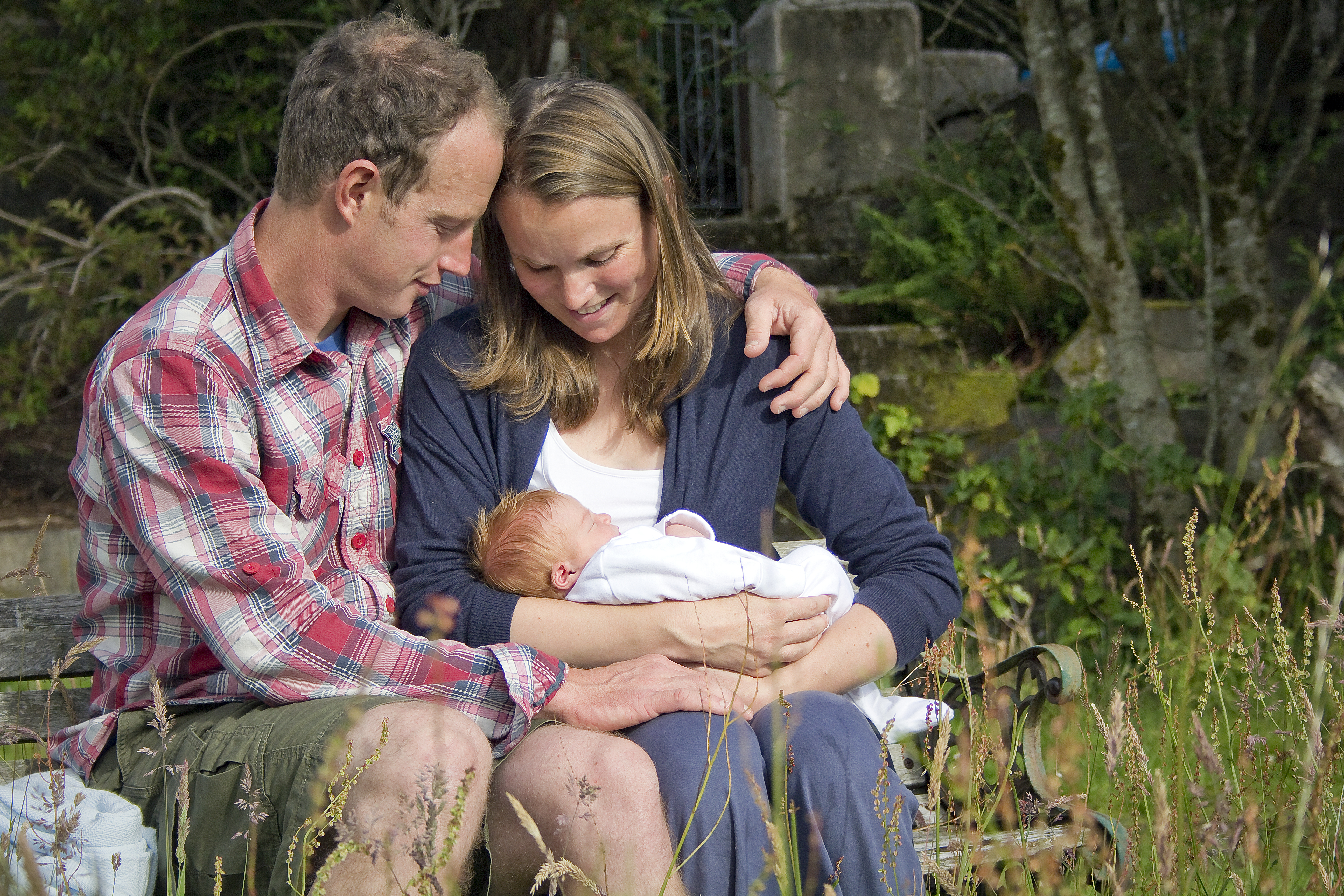
Rosie with her parents, by Anne McGee
requirements…but I am grateful that she is sleeping peacefully beside me just now, letting me write this column.
She is of course – in our humble opinion – totally wonderful (we’ve become just the sort of embarrassingly besotted parents we used to deride) and seems happy with Island life. The deep rumble of Patricia’s engine has her sleeping soundly within seconds of leaving the pier. The sea ‘breeze’ ruffles her Celtic head-full of red hair and she purses her lips stoically but doesn’t squeak.
Rosie was born in Raigmore Hospital in Inverness and we spent a couple of weeks each side of ‘the event’ living with my parents in Achiltibuie on the mainland. Since my family moved to Tanera in the mid-90s there have been three other babies living on the Island, but homebirths aren’t encouraged out here: it’s a long drive (or an expensive helicopter flight) to hospital if things go wrong.
With Rosie strapped to my front I scramble through the brambles that crowd the ruined cottages, harvesting blackberries. It is astonishing to think that these houses were once filled with children, born far from medical help. The Schoolhouse, now a holiday cottage (this week home to a knitting retreat), was 100 years ago a classroom for 20 pupils.
Last year the Island’s rowan trees totally failed to fruit; today the sheltered hillside is lit up with glossy scarlet berries, boughs sagging under their weight. I suppose productivity and populations come and go in natural cycles, and perhaps Tanera will one day be again full with children. In the meantime we’ll enjoy our little one, and the crows and fieldfares can enjoy the rowan berries.
[EWW1]The machine is telling me that this isn’t a word. I’m sure you know the right one.
 Wilder Words