March ~ April 2012

By the time this goes to print I hope to be surrounded by daffodils, willow buds and spring sunshine.

But as I write, it’s hard to imagine. I know: after weeks of wintry wind and rain it’s always difficult to believe that Spring will ever return, but this winter seems to have been particularly brutal. And it’s only early January.

This is only our third winter on Tanera Mòr; the other two were very different. I remember Mum’s sage warnings in the first year, ‘You’ve got off lightly this time.’ Treated to cold blue skies interrupted by only the occasional gale we couldn’t conceive of a wind that would sometimes blow for weeks on end.

A strong breeze, by Jean Wilder

A strong breeze, by Jean Wilder

Of course, those fabled cold blue skies – caused by anticyclones parked over the UK feeding in bitter Siberian winds – brought their own difficulties, as I described this time last year. But on an island with no roads those difficulties were largely confined to plumbing woes rather than transport dangers, and at least the frozen landscape was stunningly beautiful.

This winter the anticyclones aren’t there to block the western weather systems, so we must just hang on tight whilst storms charge in from the Atlantic Ocean.

Out here on the north west coast we’re actually lucky in many ways; so far the central belt and the east of Scotland have been hit hardest by this winter’s storms. Here there are fewer trees to blow over, and fewer vehicles or buildings for them to damage. On Tanera we generate our own power, with wires running underground: whilst many on the mainland struggle through power-cuts Rich and I are often warm and well-lit.

Smug about our intact power supply we may be, but we are also somewhat isolated. We’re only just over a mile from the mainland but that might as well be 10 miles when gales whip the sea into a churning frenzy: there’s no way we can cross, even in our bounciest boat. So we must stay put and hope that our supplies outlast the low atmospheric pressure. There was a week in December when frozen broad beans and tinned sardines were losing their charm a little. 

Boat crossings in bad weather are unreliable, and ferry cancellations are a frequent feature of travel bulletins this winter. But islands connected by roads are also vulnerable: the causeway on the Orkney island of Hoy was washed away by December’s ‘Hurricane Bawbag’.

A lot of folk round here make their living by from the sea: prawn fishing, scallop diving and salmon farming, and this winter has been disastrous for them (but less-so for their quarry). Nevertheless, people seem fairly stoical and accepting. Perhaps that’s because the fishermen know that although this seems bad, there’s nothing much anyone can do about it and maybe, apart from the few really severe days, this is just how winter is. Time will tell (but I know what my wise mother thinks).

Gosh. A whole column complaining about the weather? How very British of me.

This article first appeared as a column in the magazine Scottish Islands Explorer.

January ~ February 2012

Life on a small Scottish island is hard, there’s no denying it. Ok, so it’s nowhere near as hard as it was a century ago, before boats had engines and food had waterproof packaging; before generators and high-tech clothing and telecommunications and head torches. The physical hardship of that life fills me with awe.

Now there is a different, less physical struggle: a struggle to remain viable. Up and down this coast, communities are battling against a lack of jobs and affordable housing. Local youngsters can’t afford to stay and other young families can’t afford to come: man cannot live on beautiful landscapes alone! Houses are snapped up by retirees or as second homes for those who don’t need to wrestle an income from this wild place. The school roll dwindles, and the cycle continues.

It can feel like perhaps life in these areas is inherently untenable…but it is not all a dreich, downward spiral. Just as we battle against the elements out here, so we battle against economic trends, and there are some good weapons in the armoury.

There may not be much economic wealth around, but ‘social capital’ – the glue that holds communities together – is strong. An increasing number of communities are using that social capital to address a key issue that has long held them back: ownership of the land on which they live. It is said that ‘land is the foundation on which all other developments sit’, so this seems a good place to start.

By working together to form Community Bodies such as Trusts or Development Companies, small communities have the ‘Right to Buy’ land. The process is complicated and the ‘Financial Means to Buy’ are difficult to come by; less than twenty community land buy-outs have been successful so far…but the results are profound.

A recent review by the Scottish Agricultural College[i] found that Community Land Ownership (CLO) can reverse the unhealthy spiral; engendering private enterprise and investment, and a responsibility towards future generations.

CLO can provide the land to build affordable housing, and a space to develop much-needed jobs. These jobs need to be sustainable – both economically and environmentally. Tourism is a mainstay of many island economies; tourists come for the wildlife and scenery. These same attributes inspire artists, crafts people, writers and musicians, who can sustain a living and contribute to society – celebrating the natural world and revitalising traditions, further enriching social capital.

Much of this valued wildlife and scenery has global environmental importance: breeding sites for birds, carbon storage in peat bogs, marine stocks that sustain species other than Man. Industries that reduce this ‘natural capital’ may generate income in the short term, but at what wider cost?

Another form of natural capital sits at the heart of this economic and environmental sustainability debate: wind and water can generate power and income …but also controversy. Communities must assess whether the potential benefits (reduction in carbon emissions, income generation, potential employment and energy self-sufficiency) out-weight the potential costs (habitat damage and loss of ‘wilderness’).

Life out here on the edge is never going to be easy. But there are many efforts underway to foster resilience and ensure that communities thrive.


[i] Community land ownership and community resilience, Dr Sarah Skerratt, Scottish Agricultural College. June 2011 http://www.sac.ac.uk/mainrep/pdfs/commlandownerfulllowres.pdf


This article first appeared as a column in the magazine Scottish Islands Explorer.
November ~ December 2011

It is autumn; Tanera is quieter. The families who cavorted in kayaks and devoured mountains of chocolate brownies have migrated south, back to the classroom and the office. Even the noisy oyster catchers have left the bay, and the fulmars, black guillemots and razorbills are off for a winter wandering the open sea.

A slight twinge of loneliness, and a sigh of relief at surviving another summer season… Then excitement at all that the next stage of the year will bring.

We are galloping towards equinox: just two weeks ago there was still light in the sky at ten in the evening, but in fortnight it will be dark by supper time. The long light evenings of summer are all very well but the returning darkness has its own pleasures. We are reacquainting ourselves with the stars (Jupiter is startling at the moment), and last week we spotted a first smudge of Aurora Borealis.

Preposterous beauty
Walking around at night on the soggy paths is a perilous business, stepping around the toads who are creaking about furtively on the cool damp ground. So it’s better to avoid paths at dark times and go by boat instead: any excuse to play with water on a dark night now that the phosphorescence is blooming.

These tiny luminescent planktonic plants light up when the water moves: a preposterously beautiful sight. A bow wave is gilded; an oar through the water is a magic wand; a propeller churns up a ghostly green growl. The wee things even come home sparkling on wellies.

Daylight brings a new spectrum. Most flowers are over but the heather, having lain brown for most of the year, is now in full-on purple bonanza. Walking through the crowded clumps on a warm day, the air smells spread thick with honey. Bees are delighted. Blue heads of Devil’s-bit scabious – in Gaelic Bodach Gorm, ‘Blue Old Man’ – nod sagely above the browning grasses. They are much taller than their mainland brothers who are nibbled short by sheep. Malachite ‘hawker’ dragonflies roar around the lawn as if remote-controlled by a small boy.

A rest from the footfall
After a busy summer the ground feels ready to enjoy a rest from the footfall. And so are we. It’s good to shift gear: to set our own timetable for a bit, rather than obeying the schedule of tour boats and the needs of holiday makers. A chance to reflect on the next priorities in this ever-on-going project of keeping the Island healthy and happy.

Inevitably there will be unglamorous tasks; replacing bits of generators and repairing all sorts of broken, weathered, rotten things. But we are – finally! – reaching a conclusion on the power-generation issue, and by next Spring we hope to have a lovely array of photovoltaic cells powering the north end of the Island, and a pair of small wind turbines powering the south end.

But like many Islands, we have a population issue: the parents are moving off Tanera (only as far as Achiltibuie on the mainland) and our single highland steer is still lonely. We need to find some answers, for both man and beast…

This article first appeared as a column in the magazine Scottish Islands Explorer.
September ~ October 2011

I’m writing in my garden. Warm sunshine and just enough breeze to keep the midges at bay. Swallows are doing laps of the cottage and down on the shore an oyster catcher is muttering, though I can’t imagine what there is to fret about on such a beautiful day.

A month beyond midsummer, and the nights are drawing in: coming home last night at midnight I almost needed a torch! With all this daylight, and some good rain, the Island is looking gorgeous – vibrant and verdant, buzzing with life.

The ever-regenerating woodland creeps right down to the shore, tenacious trees clinging on in uncomfortable-looking spots. Meadows deep with foliage are bursting into colour, and almost an embarrassment of orchids: Heath Spotted, Northern Marsh and Lesser Butterfly.

Northern Marsh orchid, taken by our friend Isla Hepburn (who married Pete Abernethy on Tanera in May 2011).

Northern Marsh orchid, taken by our friend Isla Hepburn (who married Pete Abernethy on Tanera in May 2011).


Six Spot Burnet moths, with black cloaks and scarlet spots, clamber about the foliage. Common blue butterflies flit around like snatches of summer sky. Purple-tinged bird droppings tell us the blaeberries are ripe.

The harsh winter took its toll: in the bay there is just one greylag family. Fulmar numbers are down and the terns haven’t bred here. However, four eider mothers shepherd their five surviving ducklings, which isn’t a bad result. Otters, seals, dolphins and porpoises have all been spotted often, but no basking sharks yet.

The diversity of wildlife on Tanera is partly thanks to 25 years without the nibbling of sheep, deer and rabbits. This, and the Parents’ other land management efforts such as tree planting, make Tanera a welcome partner in the new Coigach-Assynt Living Landscapes project led by the Scottish Wildlife Trust. We’re excited to be part of this long-term initiative to boost the vitality of our beautiful but fragile area, for both people and wildlife.

Luckily it’s not just me who’s enraptured by the season’s loveliness; there are plenty of holidayers to appreciate it. Families, artists, divers, kayakers, sailors, all enjoying the place in different ways: playing in boats; fishing; painting; or just drinking coffee and admiring the view.

We’ve started our weekly suppers – a good opportunity for islanders and mainlanders to mingle, and so satisfying to fill the cafe with people happily chatting. It is a challenge to find ‘Good’ (responsible) food. We buy as much as possible locally: salad from the Achiltibuie hydroponicum and prawns from Coigach boats. We have venison (a healthy and ‘low-carbon’ meat) from Cairngorm National Park, and now all I need is a good source of sustainably caught fish. Perhaps I should just get out there with a rod…

A full island presents other difficulties. Pumping sufficient water keeps us on our toes. We’re determined to recycle as much waste as possible but that’s not easy; there’s no curbside collection! And the generator is developing an interesting sense of timing.

With our focus on helping our guests enjoy their precious holiday, we still find time to have fun, and to dream of longer-term projects: can Tanera be a place where young people come to learn the value of a wild place and develop a respect for nature to take into adulthood? We’re working on it…

This article first appeared as a column in the magazine Scottish Islands Explorer.

July ~ August 2011

Spring started splendidly. For an amazing three weeks in April and May my waterproofs hung redundant on their peg; not even the ever-present Yellow Wellies saw much action. This was fantastic for Tanera’s first non-family wedding; in all the months of careful planning we never dreamt we’d be using our cache of umbrellas to save the congregation from sunstroke.

The hot dry weather was less fantastic for the wildlife on the mainland, as several wild fires raged through the tinder-dry vegetation devastating thousands of hectares of precious habitat. Quite remarkable for a “drowned landscape”.

My days are spent mixing up vats of chocolate brownies or soup or stew for those who visit the Island on day trips or for our residential courses in ecology, art, willow weaving, writing or kayaking. From our winter population of four we are creeping up to a high of perhaps forty temporary residents: both holiday makers and ‘working holidayers’ who help run the cafe and Post Office.

It’s not only the human population that is increasing. Yesterday I saw the first eider ducklings: five tiny brown pom-poms dabbling in the seaweed. Soon the mothers of other broods will work together to form a kind of crèche to protect their offspring from predatory gulls. Sadly we have seen fewer greylag gosling – larger, greenish pom-poms: we blame the brutal winter for the adults’ poor condition and inability to breed.

Our most aerobatically elegant visitors – swallows and arctic terns – flirt with the idea of breeding on Tanera, and it would be lovely to see them succeed. But there is one summer visitor whom we struggle slightly to welcome: the cuckoo. His first call is an exciting harbinger of summer, but the joy wears off at 4am when he hasn’t shut up all night. One holidayer commented ruefully: ‘now I know why cuckoo clocks are so effective’. 

The inaugural Coigach Coastal Rowing Regatta took place on Saturday in a sheltered harbour on the mainland. Despite ‘challenging’ weather it was a huge success: crucially some of the local teams were victorious (particularly those blessed with Tanera muscles!), so our hard winter training must have paid off. Visiting teams commented on the strong community spirit of Coigach; they’re right – and this lovely wooden boat certainly had everyone working together to create a great day.

On Sunday a flotilla of the beautiful boats was due to row from the mainland to Tanera for a well-earned brunch. Sadly the sea was too ferocious even for these intrepid athletes so our brave ferry Patricia (and her brave skipper) stepped in, and a lot of soggy people had a happy afternoon eating sausages and reliving the glories of Race Day in our cafe.

As I write, sheets of rain thrash the windows. The sea is a deep menacing blue frothing with white. Even gannets are taking refuge in the relative shelter of the bay. Who knows what meteorological delights the Summer might bring…

This article first appeared as a column in the magazine Scottish Islands Explorer.

May ~ June 2011

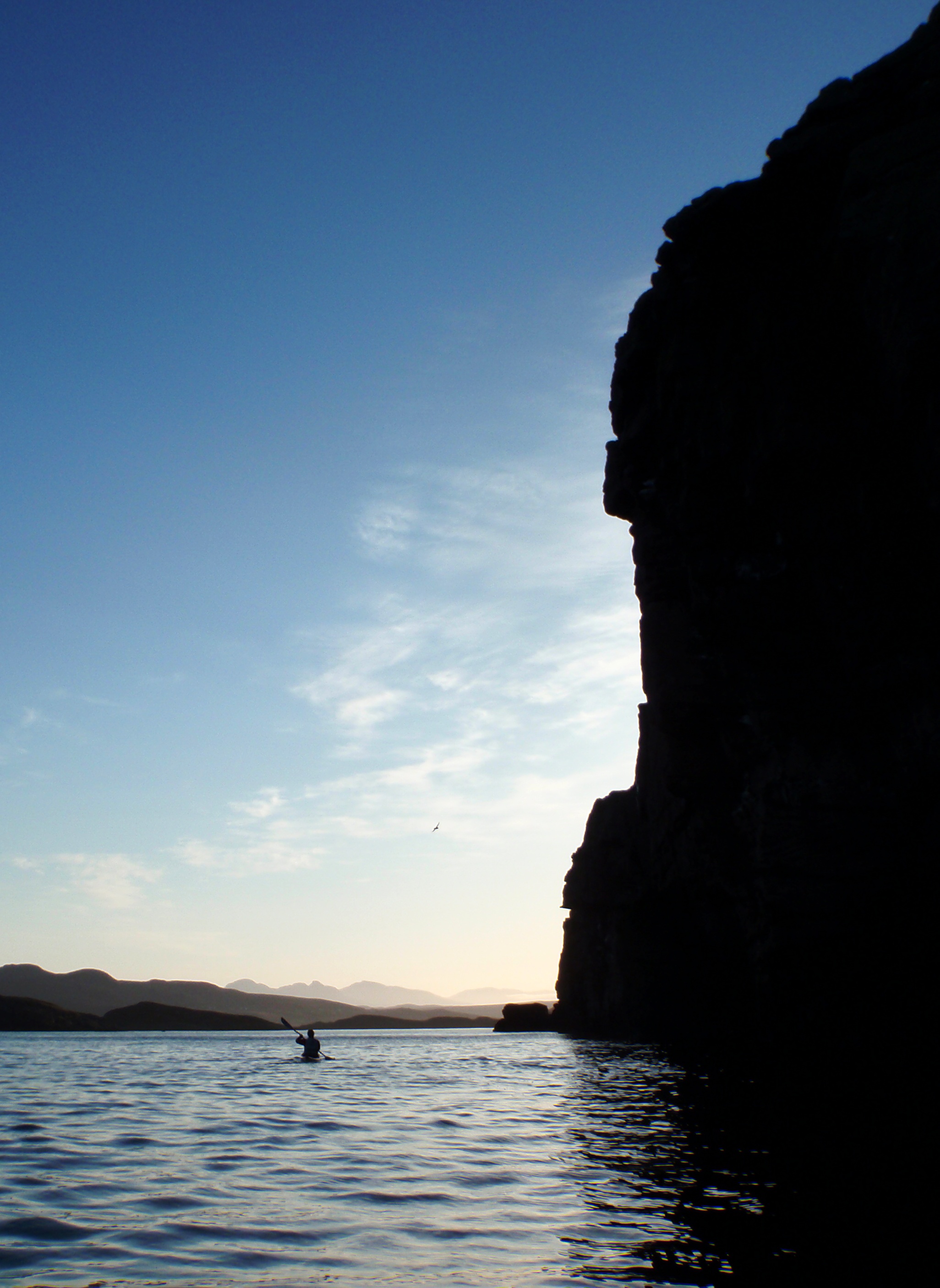
It is curious how, when there aren’t many other people around (three, to be exact), different noises substitute for those of human companionship. As I write in early March, greylag geese are hanging around in romantic pairs on beaches and in long grass; their soft chuntering is so familiar, subconsciously comforting in the way that friendly voices are. Admittedly their uproarious leave-taking is less soothing. Early morning kayak in the Summer Isles

Oyster catchers have been away through the winter, giving their breeding grounds a rest. They are returning now and their hysterical screeches, graceful flight, and less graceful carrot-faced strutting on rocks, are a cheering sight. And of course one shouldn’t have favourites, but mine are the eiders who gather in gently cooing rafts in the bay.

Apparently the porpoises we see are resident year-round, but I’ve only seen them in the summer months. But when Rowena Birkett-Jones (who will teach a Sketchbook course here in October) visited in March she was blessed with two sightings of these quiet cetaceans, as well as a white tailed eagle circling high in a blue sky.

It’s not all about nature spotting; there’s work to be done! The wood-fired replacement for the elderly Rayburn in Murdo’s Cottage is installed at last. At quarter of a tonne, it was no small feat shifting it across the sea, onto the island and into the cottage. But such extra exertions are needed if we’re to reduce our dependence on dirty and increasingly costly oil.

Before growth starts in earnest we have been coppicing alders and continuing to thin out the Sitka spruce plantation. Heron families, gawkily balancing in neighbouring tree tops, squawk nervously. But careful and gradual removal of non-native trees to make way for enthusiastic new growth of birch and rowan is the Right Thing for the island’s wildlife, and provides us with fire wood and construction timbers.

Over on the mainland, the Coigach Lass – the elegant wooden skiff built by the community as part of the Scottish Coastal Rowing project – is back on the water. Have the months of gruelling winter training been worthwhile? Will the teams be as victorious in 2011 as in 2010? We’ll see … the season starts with Coigach’s inaugural regatta in May, followed by a well-deserved Sunday brunch in Tanera’s cafe.

We’re almost ready for the 2011 tourism season, which starts gently with weekend courses and cruise boat visits. This year’s Summer Isles stamp issue will be launched in May featuring photos of Frank Fraser Darling’s life in the Summer Isles, to coincide with the re-printing of his books, Island Years and Island Farms, with an introduction by Professor Iain Stewart.

The parallels between the Fraser Darlings’ experiences 70 years ago and contemporary life are fascinating. Of course we have a far easier existence (central heating and broadband come to mind), and it’s not surprising that we share his elation at being here and his frustrations when wild weather interrupts work. But his feelings about the need to look after a place, of hard work and the importance of fostering wise use of resources – both natural and human, could have been written yesterday.

This article first appeared as a column in the magazine Scottish Islands Explorer.

March ~ April 2011

Life on an island is a lot about self-sufficiency. Not so much in a bucolic ‘Tom and Barbara’ way; more in a ‘responsible for all our own utilities’ way. This is sometimes a good thing: uninvited telephone callers promising a better deal for our heating/electricity bills are told (triumphantly) that, “we’re off-grid”. Sometimes it’s less of a good thing: when the lights go out or the water stops flowing, the buck stops with us.

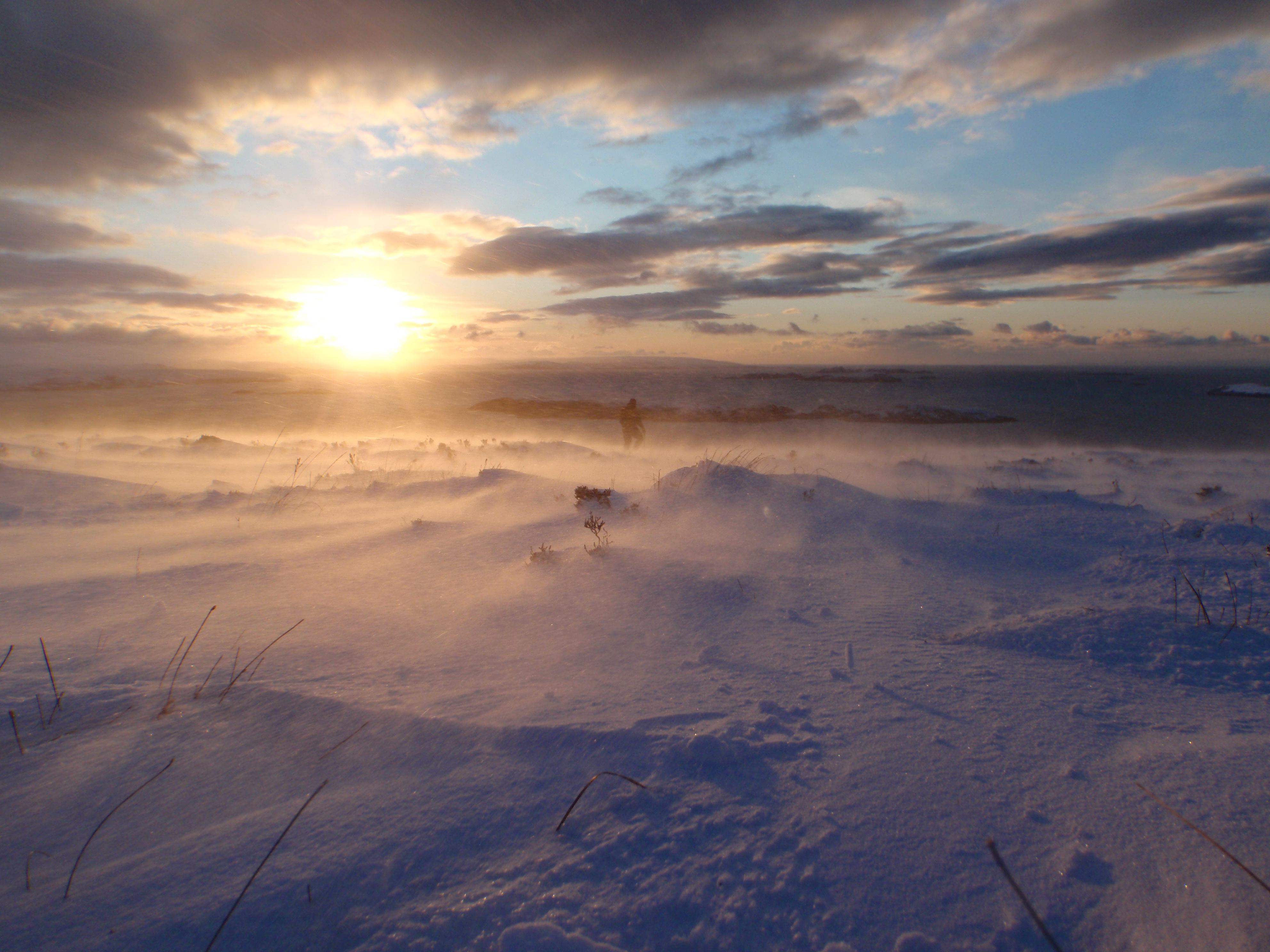
My parents, who have lived on Tanera for 15 years, have never experienced a winter like this one. Cross-country skis bought for their new life amongst the mountains hang unused in a shed. The Island’s water system – now 40 years old – was designed for a maritime setting, and certainly not to cope with persistent sub-zero conditions. Looking out to the Summer Isles through the spindrift

Unusual weather and unoccupied houses, together with our efforts to complete ‘improvements’ to the water treatment system, resulted in some uncomfortable days (over Christmas!) without running water, and a steep learning curve labelled ‘plumbing’. We are grateful to have the tools and the gumption to fix our own leaks, as well as a wonderful tutor of ‘bush plumbing’: my father.

Luckily we managed to rectify most problems in time for a merry gang to enjoy Hogmanay on Tanera, taking over the Schoolhouse and Farmhouse for four days of festive, creative and ragged outdoor fun. Our ambition for winter 2011 is to have some mid-term lets; the light, loneliness and landscape could be a paradise for writers and artists…

The heavy snow didn’t stop otters getting about the Island. In the soft powder we could follow their clear ‘toboggan’ tracks – dragging their tummies and long thick tails – out of the sea and over to the fresh water lochans and streams to wash. A goldcrest watched us harvesting our Christmas tree.

Rich and I have learnt to embrace the winter: curling up by the fire to read and educate ourselves about the rich natural and cultural heritage of the Highlands. We are excited that two books by Frank Fraser-Darling, an eminent ecologist who lived on Tanera in the 1930s-40s, will be re-printed in the spring.

Of course we must also plan the season ahead: we’ve got various new courses making the most of our natural assets; wildlife, water and scenery. And it’s lovely to be hearing from previous visitors – many already feel like old friends – and new ‘Tanerans’ too, dreaming of their summer adventures here.

My chickens are also dreaming of summer: they started laying in early January. Other birds are less enthusiastic. The greylag geese gorge on our grass (particularly when snow melts faster here than on the mainland), and soon will be pairing up noisily. We hear the occasional haunting cry of a curlew.

A few eider ducks and their smart piebald drakes are around, but it will be a while before their heart-warming cooing and the snipe’s drumming tail feathers herald spring and all it entails. In the meantime we’ll continue to relish our peaceful wintry existence.

This article first appeared as a column in the magazine Scottish Islands Explorer.