
In the small hours of a wintry night I heard an avian uproar. It sounded rather like a chicken in distress but I told myself that it was more likely a greylag goose getting uppity over nothing, as is their wont, and went back to sleep.
I thought nothing more of it until I visited my favourite fowl the next morning. I shook a tub of grain and expected the flock of three to bound towards me on their ungainly fluffy legs, but all was quiet. Feathers fluttered around the coop.
My heart sank and my blood pressure rose when I saw the first corpse, partially stuck beneath the wall of the coop. The second was inside the house, decapitated like the first. The third was nowhere to be seen.
I couldn’t imagine how this had happened: we proudly claim to have no predators on the island – no foxes, pine martens or polecats – and therefore a rather relaxed approach to chicken security. Had an otter turned bad? Or did we have some monstrous rodent on our hands?
As I carried the bodies to a shed for safe-keeping I startled something in the woodpile. Screeching like a cartoon schoolgirl, I nonetheless managed to catch a glimpse of the beast: smaller than an otter, larger than a rat…a rich sleek coat, unmistakably mink-like…
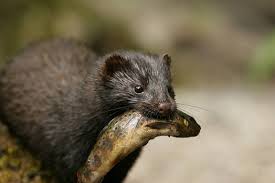
American mink, by John McAvoy
The following day local Mink Control Officer Gunnar Scholtz arrived, armed with humane traps and encouragement. Gunnar and his colleagues are on the frontline of Scotland’s war against mink. Working systematically throughout mink habitat, they track and trap the invaders, sending the bodies for analysis by researchers at Aberdeen University.
The American mink, Neovison vison, has been established in the wild in Britain since the 1950s following numerous escapes and releases from fur farms. It is one of many ‘invasive non native species’ which damage ecosystems and economies across the globe.
Islands are particularly susceptible to invasive species because of their fragile ecology. Amongst other factors, island species evolve with relatively few predators and therefore have less-developed defence mechanisms than their mainland counterparts (or, in the unfortunate case of my chickens, are less well protected).
On the Western Isles where most bird species nest on the ground, mink have had a devastating effect. Voracious and not fussy, mink will eat eggs, young or adult birds. Many species suffer, including terns (arctic, common and little), black throated and red throated divers, corncrake, dunlin, ringed plover. Mink predation also has a significant impact on wild salmon, which in turn impacts on the economy.
With Gunnar’s help we humanely trapped and dispatched our mink within two just days of discovering it. But the short crossing from the mainland is nothing for an ambitious mink, and he may not be the only one to make the swim. We are keeping vigilant whilst ground nesting birds breed. Losing three chickens was bad, but the thought of the vulnerable eider, greylag, oystercatcher, curlew and snipe being killed by an unnatural interloper is unbearable.
This article first appeared as a column in the magazine Scottish Islands Explorer.
 Wilder Words